Search This Blog

Showing posts with label Maus. Show all posts

Monday, November 25, 2019

Maus: A Survivor's Tale. And Here My Troubles Began, Chapter 5 - a Review


Maus: A Survivor's Tale. And Here My Troubles Began (1991)
"The Second Honeymoon" - Volume 2, Chapter 5
Art Spiegelman

After a year of once-a-month reviews, we have come to the conclusion. In storytelling time, we've bridged 1978-1991; the events therein covered nearly 60 years. It has been a tale of scope and of scale, and in my mind this is one of the most important comic books ever produced. One can argue about other books' lasting impacts, or financial appreciation. But Maus was somewhat of a game changer across the market, as it brought "comix" to a mainstream audience and caused the general public to take notice of the genre and its storytelling possibilities. I long ago lost track of how many times I've read this, but I don't care - I know I'll keep coming back.

In this final chapter we wrap the events of the war years, and see the almost-end of Art's and Vladek's relationship. It's a fitting curtain drop, one that is poignantly touching.

100-Word Review:
As Art set about continuing his work on the second volume of Maus, he was interrupted by a frantic call from Mala, his stepmother. She’d gone back with Vladek, and they were in Florida. Vladek was quite ill, and Art needed to head south to help them return to New York. Once stabilized, Vladek told Art about the days immediately following the war - but he was separated from Anja, his wife. After time in Displaced Persons camps and another bout with typhus, he eventually made his way back to Sosnowiec, where he was reunited with his beloved. He was later able to secure employment and rebuild his finances, and the Spiegelmans made their way to the United States.
Most of this chapter takes place in the present. It is a satisfying finish to the telling of Art's and Vladek's stormy relationship.


The Good: Art's a good son, in spite of how crazy his dad had driven him through the years. Art felt a real sense of responsibility to Vladek and to Mala. It's pretty clear that the role of caretaker was not comfortable for Art, but he did it and did it well. I thought, especially given the way the first volume had ended, that the story had a bittersweet ending. "Happy" was probably out of the question, but I didn't walk away in a fit of depression.

It was important that Vladek related the trials he faced in reuniting with Anja. It should not be lost on anyone that upon liberation, survivors had no assets. And when we see stories of the murders that took place in Poland when Jews tried to return to their former homes and property, the barriers to normalcy seem all the steeper. News in those days of course traveled slowly, and knowing the destruction of German infrastructure it's a wonder word made it from place to place at all.


Across the entire narrative, I was impressed by Vladek's resourcefulness. The vignette about selling hosiery (out of place in the chronology of Vladek's biography but told as such because it was topical to the narrative of that page) was amazing. I'd not call Vladek a scammer, but I would say he was more adept than most at sniffing out a deal.

The reunion of Vladek and Anja was appropriately low-key. Art let the event speak for itself.

The Bad: Over the past couple of chapters, I think we really got a taste for the absence of Anja's perspective in the events at the end of the war. Vladek's destruction of her diaries effectively omitted a large wedge in the narrative pie. When she is present in the story again, there's a weight to those pages in which she was absent. I don't know that it overall diminishes the impact of Maus - after all, that her diaries were destroyed is an important ongoing element in the relationship between Art and his father. But it certainly would have added to the trajectory of chapter 4.

I am never able to understand Vladek's motivation for having his picture taken in a camp uniform. I'm glad Art used it in the book, but it's never clear to me why anyone would want to be near that. When I see those uniforms on display at the United States Holocaust Museum, I always have a sense of revulsion. To stand mere feet away, and to know what they may have been used for and most certainly what they symbolized, sweeps me with emotion.

The Ugly: The above-mentioned pogroms and killings in Poland and elsewhere at the conclusion of the war. As Vladek relates, for this they survived?


For those of you new to this series, I'd invite you to use the Repository of Reviews for links to my thoughts on each of the 11 chapters of Maus. And to anyone who has been along for the entire 11-month ride, I thank you. I've remarked along the way that this has been a real labor of love for me, and these reviews are a goal I've long held. It has been gratifying to see the "project" come to a conclusion; I hope you've appreciated the story as much as I have.

Monday, October 28, 2019

Maus: A Survivor's Tale. And Here My Troubles Began, Chapter 4 - a Review


Maus: A Survivor's Tale. And Here My Troubles Began (1991)
"Saved" - Volume 2, Chapter 4
Art Spiegelman

Is it possible for a story featuring the Holocaust and a modern dysfunctional family to have a happy ending? We're close to finding out, as one month from now we'll witness the conclusion of Art Spiegelman's masterpiece in biography/autobiography. But until then, today we'll be party to the winding down of Vladek Spiegelman's trials in Nazi-occupied Poland. The Soviets had drawn near in the east, and the Americans and Canadians were pushing from the west. The war was nearly over... but would that stop the Jew-killing?

100-Word Review:
World War II spiraled toward its conclusion in the spring of 1944. Vladek and his fellow prisoners had been forced to go on a death march as the Soviets had approached Auschwitz. Arriving at Dachau, just outside Munich, Vladek’s odyssey was far from over. Moved to the Swiss border, then making his way across the German countryside, Vladek evaded murder at the hands of the Wehrmacht on more than one occasion. Assisted by the Red Cross, taking advantage of abandoned German provisions, and finally meeting the Americans, Vladek’s return to life could commence. But what of Anja…?
 

As is typical of the beginning of each chapter throughout both volumes of Maus, the story picks up with a scene between Art and Vladek. As we begin, the discussion is about money, and loneliness... so let's jump right in with

The Good: By now I've made it abundantly clear that I feel the "here and now" scenes are as important to the power of Maus as are the war-era history. Art the storyteller often uses dialogue with his father to frame what is to come. Here we see Vladek bemoaning money, his health, and the fact that Mala had left him. He's pretty down in the dumps, and perhaps that is made worse by Art's lack of patience with him. Art snaps at the suggestion that he and his wife, Francois, could move in with Vladek. He bristles again at the request to help Vladek hang his storm windows. Art insists that Vladek has enough money to pay someone to a) stay with him for healthcare, and b) do handyman jobs around the house. But Vladek is having none of it, having been conditioned during the war to conserve every resource. It's made him somewhat of a pathetic victim of his own history, but that's where I find these elements of Maus to be so powerful -- we're not only privy to the circumstances in the past, but to the bitter fruit born of those years.

Vladek answers Art's question about his mother's whereabouts when Vladek was in Dachau. Vladek makes the point that Anja and other women had been marched from Auschwitz at a different time than the men Vladek was with. Herein lies the core of the Nazi camp system - not only was it sprawling, but it was well-organized. There were female SS, and those women (perhaps along with male guards, too) would have supervised the evacuation. What's more, there would have been stops along the way for processing. It's likely that the women might have taken a path to camps where there were female SS on those premises to assist. Hence, the men would not have known exactly where the women had been taken, and also not necessarily their future destinations.

It's well worth noting on the page samples above a couple of things: First, as the prisoners figured out that the war was over, it did not equate to safety. As you see, within a short while Vladek and his mates found themselves facing the business end of a Wehrmacht patrol. But the war was over, you say - what is this? It does give one pause, and raises some questions: Were the Germans so infected with antisemitism that even at the end - no, past the end - they would still seek the conclusion of the Final Solution? And what else could possibly be a benefit for those soldiers? Germany had no assets, the government was going to capitulate, the economy was in shambles for the second time in a little over 20 years... where would be any sort of reward? Second, the villager - following no orders - attempts to turn in Vladek and his mates. What were his internal motivations, because one would have to assume that any external pressures had desisted by this juncture.

Vladek's reaction to "real food" is an important tale as well. When you consider how meager his sustenance had been over the past several months, his body was in no way conditioned to digest anything thick like milk, or with any grease such as chicken. So that they got sick is a story you can find often, the more survivor testimonies you encounter.


I enjoyed the interactions between the American GIs and the survivors. I crack up every time the soldier thanks "Willie" for the shoeshine...

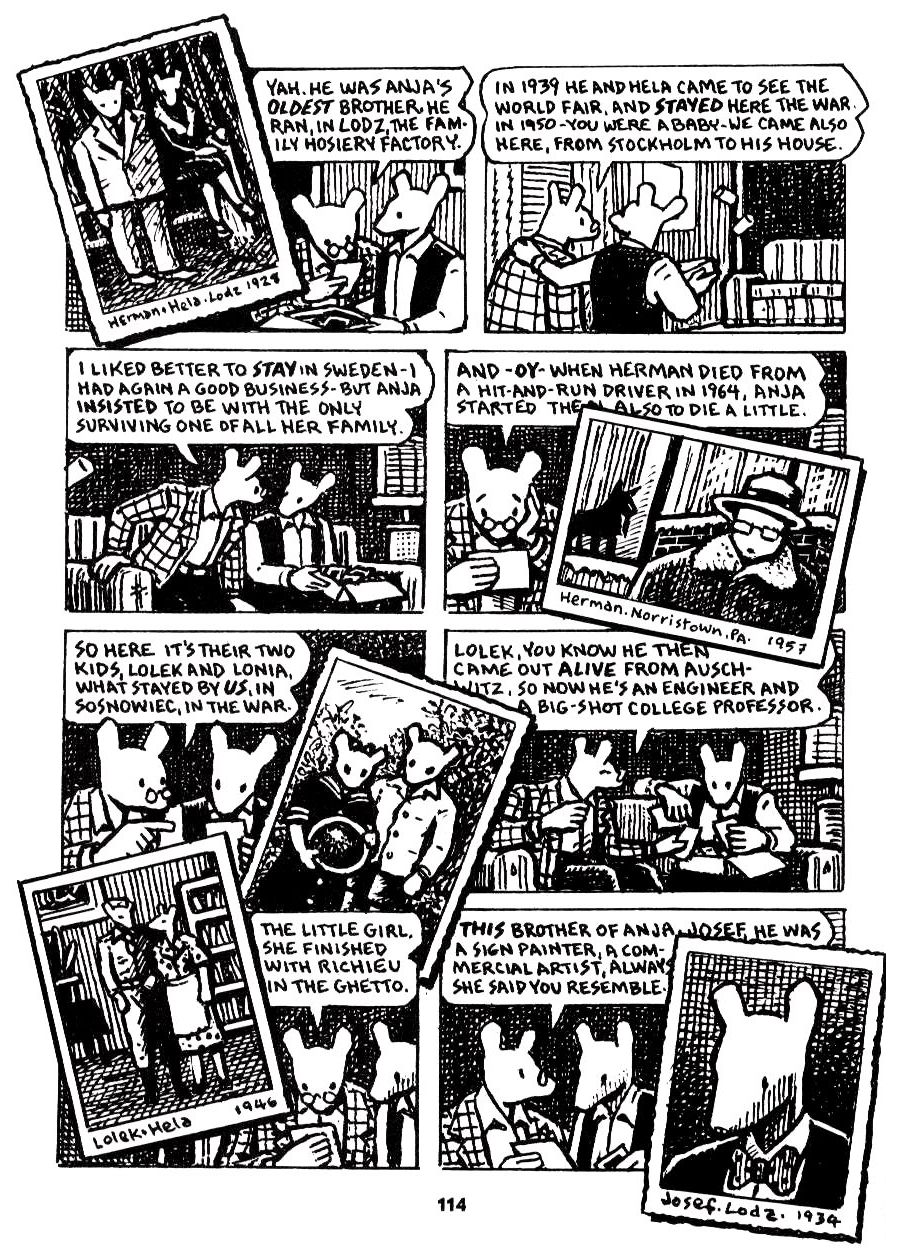
The Bad: The scene above, with the photographs, gets to me every time. And the Spiegelmans had photos. So many survivors lost not only the lives of loved ones, but these keepsakes of memory as well. I feel badly each time as Vladek narrates the stories of all of Anja's relatives, but then tells that almost his entire family was lost. The page below, where Vladek's body is basically a splash page broken by the sad stories he tells Art, is powerful.

The Ugly: I'll mention here that films like Schindler's List, and other resources, often give the viewer the impression that once the war was over, it was end-of-story for the survivors of Hitler's persecution. This couldn't be further from the truth, as many survivors spent years in Displaced Persons camps, or wandering Europe searching for loved ones. The last of the DP camps did not close until 1960! And emigration...? To where? Most nations did not relax their immigration quotas. Keep in mind, too, that Israel is not sovereign until after the events of 1947-48. Perhaps this is why there's one more chapter in this book. See you in four weeks.


Monday, September 30, 2019

Maus: A Survivor's Tale. And Here My Troubles Began, Chapter 3 - a Review


Maus: A Survivor's Tale. And Here My Troubles Began (1991)
"...And Here My Troubes Began." - Volume 2, Chapter 3
Art Spiegelman

Many folks who casually encounter the history of the Holocaust might make an assumption that as the war wound down mid-1945, the worst was over. They'd be wrong. Another assumption people make is that after May '45 there was a happy ending for all involved. Again - they'd be wrong. In today's review, we'll see what happened to Vladek Spiegelman in the winter of 1944-45, and how his son Art juxtaposes those circumstances with Vladek's behavior in the "present". To my point, you'll notice the title of this chapter, above. Maus contains 11 chapters... and Vladek says his troubles began when he was 80% of the way through the story?

100-Word Review
Art and Francois are staying with Vladek in the Catskills after Mala had left him. Vladek was under the impression that they’d stay for the duration of the summer; Art had other ideas. In another stroke of brilliance, Art uses present-day slice-of-life situations to augment the wartime incidents that shaped Vladek’s life. In the winter of 1944-45, the Germans were retreating back to the Reich as the Soviets closed in the east. Forcing prisoners on death marches so that they might later serve as labor, Vladek was part of an odyssey from camp-to-camp, on foot and on trains. His endurance would be pushed to the limit.

The Good: As mentioned previously, I've worked with colleagues who don't find Maus to be an effective tool for teaching the Holocaust. They don't care for the vignettes that take place in the present, feeling those episodes detract from the history. I'll stand by my position that it's those "modern day" scenes that strengthen the narrative. Art Spiegelman, through showing his own reactions to his father, teaches us how he feels as the child of a Holocaust survivor. Through Vladek's eyes and actions, we get a feel for the impact those events in the Nazi era have had on him ever since. So when our story opens with - basically a trip to the grocery store - we see Vladek's need for comfort, his frugality, his impatience, his self-reliance, and the worldview that is particular to him. Art is sometimes a guest in that world, often an intruder, but frequently a victim of it in his own right. This is a complex narrative, and one I want my students to have to deal with. For me, the way in which this multi-layered story is presented may go beyond other survivor stories. That's in no way meant to denigrate others; rather, I'm stating my affinity for this book.

The "death marches" are depicted in all their uncertainty and horror. As stated at the top, many people might think that the evacuations from the camps signaled an ending. To the contrary, it actually brought the next phase of the Holocaust, and the end for many who had been clinging to life. The marches, as Vladek tells, were under brutal conditions. January in Poland, I've heard, is not where one would like to be. Coupled with severe malnutrition and insufficient clothing, and the physical duress of daily marching on bodies with little muscle mass remaining, many lost their lives after years of imprisonment. To have lived so long, only for it to be dashed as the end of the war approached... I liked that Art included in Vladek's narrative that the prisoners were registered to other camps on their way from Auschwitz into the Reich. The German camp system was an intricate network of various purposes. There were forced labor camps, transit camps, death camps, concentration camps, prisoner-of-war camps. So that Vladek and his fellow prisoners were processed along the way to Germany makes sense, and supports the degree to which Germans kept records of this greater event. It also speaks to the folly of those who seek to diminish or even deny the Holocaust - the records are visible, and were mostly crafted by the Germans and their collaborators.

I found the encounter with the Frenchman uplifting, for both him and Vladek. It was truly a symbiotic relationship and one that preserved Vladek's life. I enjoyed at the end of that part of the story that Vladek related that the two men had corresponded for years after the war. It's important to note, too, Vladek's point about the Frenchman being able to receive packages from the Red Cross. Political prisoners and POWs from the west were treated quite differently from those racially targeted by the Nazis.


I think the point of Vladek's declaration that his troubles were just beginning gets at the greater issue of control. In every prior period on which Art questioned his father, Vladek was always able to relate some manner in which he was able to alter his circumstances. It might have been financial, through bribery. It might have been fortuitous, by meeting someone with whom he could get supplies, information, or a place to hide. It might have been adaptive, where Vladek was able to quickly draw on prior knowledge or even learn a new skill. But here - now things were changing rapidly, with no anchors. The surroundings were different, the guards and other prisoners were different, and there was no work to do. So that anyone could hope to create a situation where they might save themselves seemed unlikely. And then... Vladek got sick with typhus.

The Bad: Within the story about Vladek's contraction of typhus, his telling of how it was to have to walk across corpses on his way to the toilet, and that his hoarded bread was stolen from him, were gut-wrenching. That he said that someday it could be him - his head - that sick prisoners would walk on, was horrifying. I found that to be just as unsettling, if not moreso, than trying to wrap my mind around the long ride crammed into the cattle car.

The Ugly: Two ideas stand out to me here. To the end, the complete mistrust, the deceit, that the Germans leveled against their prisoners. In the scenes where the Jews attempt to bargain with the guard to allow them to run off into the forest during the death march, that the Germans take the bribe and then shoot them anyway speaks to the complete breakdown of human relations, of any sense of care at all for their fellows.

Additionally, the scene at the end of the chapter when Francois picks up the Black hitchhiker somewhat forces us into a judgment of Vladek and how he could even foster any racist tendencies. While we may be quick to judge, that in itself is an ugly side of human behavior. We might think, "Wow, I could never..." or "I'm glad I'm not like Vladek here." The danger there is that we put Vladek's experiences in a box of our choosing - we decide how he should act. Additionally, and let's take this further - we give the Germans a victory in that we not only decide how Vladek should act, but we ascribe that desired behavior to a "right" response to what the Germans had put him through. But don't we then show that the Germans not only ruined the life he had, but decided how he should live his life henceforth? Racism is wrong, but so is projecting values onto another person and telling them how they should live or think. I know. It's complicated...

Monday, August 26, 2019

Maus: A Survivor's Tale. And Here My Troubles Began, Chapter 2 - a Review


Maus: A Survivor's Tale. And Here My Troubles Began (1991)
"Time Flies" - Volume 2, Chapter 2
Art Spiegelman

In the 11 chapters that comprise Maus, today's material is the most important. You might see that as a judgment on my part, but I'll stand behind the statement. Art Spiegelman's emotions at the beginning of the chapter, languishing over the proper way to depict the events of his parents' lives while prisoners at Auschwitz, are juxtaposed with the then-present fall-out that had affected his adult relationship with his father. Several vignettes that get to the core of the hell that was the Holocaust drag the reader through a history-driven storm. As I've said in previous reviews, I have read Maus perhaps 50 times (maybe more). This chapter always requires several pauses for reflection and digestion of the material. Holocaust literature can be that way.

Because of the large volume of images included in today's review, I'm going to lead with the complete introduction to the chapter, as I feel it is imperative to one's understanding of not only Art's dilemmas, but to a greater grasping of the magnitude of the Holocaust.


100-Word Review:
Art Spiegelman struggles with the magnitude of presenting his father’s story. Wanting it to be truthful, tasteful, authentic, and accessible, Art is overwhelmed with a sense of responsibility and inadequacy. Seeking input from his therapist, a survivor like Vladek, Art tries to wrap his mind around the “Auschwitz experience”. We see that series of events through the eyes of Vladek, as he narrates his own travails as well as those of Anja. Art shows the brutality of kapos and SS guards, and the mania of the last days of the Final Solution. In the end, we’re left shaken at the notion that anyone could survive that.
The Good: The scene(s) I've depicted at the top of the post really strike at the core of what this amazing book is about. From Art's grappling with Vladek's experiences to feeling incapable of depicting them with integrity, and then on to his feelings about his own life and relationship to his father and also to his father's memories... Those first six pages hold my attention every time I read this. Specifically, I think I've personally taken the most value from the therapist's demonstration atop the sixth page. If we search our own memories, we've all had those moments of abject fear, usually coupled with an intense surprise. I liken it to those days of youth when a sibling or playmate would lie in wait, often in the dark, waiting to pounce from the shadows with a hearty yell. That feeling of the hot rush through the chest, the rapid increase in breathing rate, and a belief that one could actually see one's heart about to pound through the rib cage... "It felt a little like that, but always." Man... my mind cannot grasp having that feeling of frightful distress, every moment of every day. And I thank God I can't grasp that.

A second important element of this chapter is Art's meticulous depiction of the physical layout and other aspects of both Auschwitz I and Auschwitz-Birkenau. Throughout the book, I've treasured Art's care in showing readers the hiding spaces and other important settings to the Holocaust experience. I'll break from the chronological display of art to feature samples of this narrative.

If you search "Auschwitz" using Google Maps, you can get an aerial view of the Polish city of Osweicim. You'll find Art's map to be very accurate. You'll also find that today, there is a subdivision of private homes across the street from Birkenau. When I was in Poland in October 2008, I was struck during our times in Osweicim that going past those camps was someone's daily commute. I had a difficult time wrapping my mind around that. You should know, too, that of the five gas chambers/crematoriums at Auschwitz, only the one at Auschwitz I still stands; the four at Birkenau were destroyed near the end of the war. One was blown up in a sabotage by the prisoners who worked in Crematorium IV; the other three were destroyed by the Nazis as the Soviets advanced on the camp.


An almost throwaway question and answer in this chapter really resonated with me when I was at Auschwitz I. Art asks Vladek about the orchestra that played daily as prisoners were marched in and out of the camp on their way to/from labor. Vladek remarked that he remembered no such thing - why would there have been an orchestra? Art countered that it was well-documented... And when I was there, signage exists at the very point where prisoners would have passed beneath the famous gate.


The issue of hunger was dealt with throughout the chapter. Dying slowly, sacrificing rations to save for later or to trade for other necessities - yes, a black market existed even in Auschwitz. These scenes tear at the heart; of particular note is Vladek's description of the contents of the soup and of the bread.

 
Vladek's care for Anja was another series of events that ran through this part of the story. Of importance was the benevolence of Mancie, a fellow prisoner but who had a bit of authority and could move about more freely. That she assisted Vladek in making contact with Anja, and then further continued to help them exchange notes - at great risk of not only their lives but certainly her own - showed that even under the worst circumstances some would strive to maintain the humanity of others. Notice in the sample below right that to be suspect of fraternization meant certain punishment - even death without question. Dead prisoners could always be rationalized by guards or kapos, especially as there would be little effect on labor requirements. After all, there was an almost-endless supply. Note, too, the final panel on that page, and scroll back to the photographs from the orchestra conversation - see how Art homaged the signage at Auschwitz I? In MetaMaus, there is a CD-ROM included and on that disc one can find the home movies Art and Francois shot while on a research trip to Auschwitz in the early 1990s. It's a great add-on to that book, and to the great Maus experience for the reader.


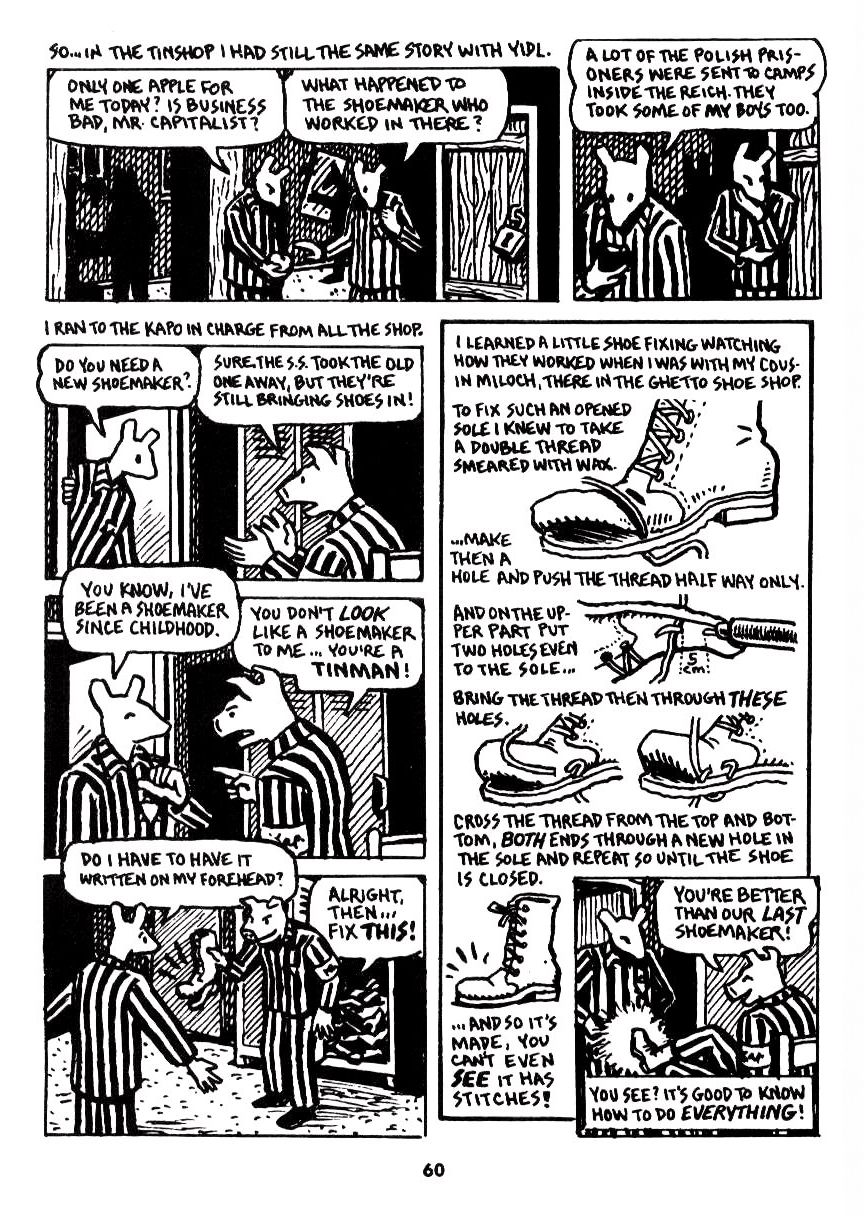
The Bad: In regard to the quality of the storytelling, nothing was bad. But I wanted to focus here on the randomness of the Holocaust. It's been said many times - it wasn't always "the best" who survived, nor was it "the worst" who died. It was completely random. And although Vladek was incredibly resourceful and able to make himself useful (see Art's discussion of this above, in the first series of page samples), his life still hung on the whims of the kapos and the SS. The vignette of Vladek becoming a cobbler bears this out, as he thinks he has saved his life to see another day. Yet, when the SS officer wants his boot repaired there is no margin for error. And that Vladek was rewarded, and complimented, flies in the face of everything we might have expected to happen. Now I'm back to the therapist's description of Auschwitz: "It felt a little like that, but always."

The Ugly: Lastly, I need to mention the terror of the camps. That feeling of impending death, not coming at some point, but imminently. It could be due to a mistake or to falling short of expectations, it could come at the flaring up of a kapo's anger, or a guard's sadism. But knowing - with all your mind and heart - that death was literally a second away, had to destroy one's confidence and faith. 

I don't know about you, but I'm spent after this. Chapter 2 always hits me that way, as I said near the top. Next month we'll begin to move toward the end of the war. That will bring it's own new troubles as we'll see. Indeed, the next chapter is titled, "And here my troubles began".

Related Posts Plugin for WordPress, Blogger...